Monday, 3 June 2013

Corpus Christi


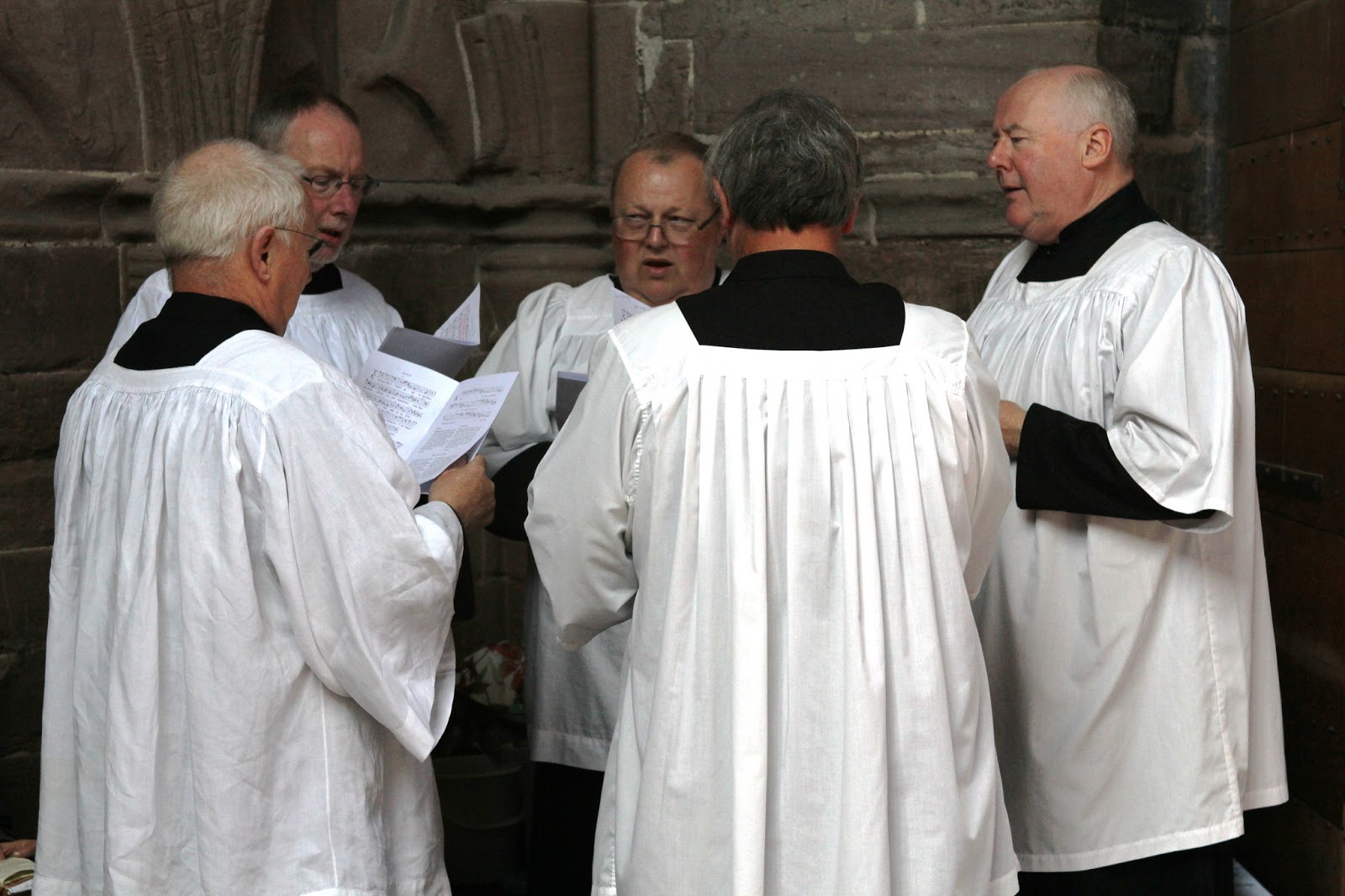
We had practiced the Sequence Lauda Sion on Thursday for the Sunday Mass at Holy Spirit. The Mass was well attended
The gifts of the Holy Spirit are written on the stained glass window: sapientia, intellectus, consilium, fortitudo, scientia, pietas, timor Domini (wisdom, understanding, counsel, fortitude, knowledge, piety, fear of the Lord).

Two servers arrived, so I could sing with the Schola.
We are sounding more confident, according to my son.
In the Kyrie we remembered to sing Chreestay and our pacing in the Gloria was good. In our run-through before Mass, we had been too loud at the endings and had the emphasis in Deus as De-us, rather than Deyus. But we were fine at the Mass itself.
Lauda Sion is one of Aquinas's great Eucharistic hymns.
At the Communion, we sang one of his greatest hits Tantum Ergo.

Here's a short musical description of Thomas Aquinas's life and work sung to "Venus" by Bananarama.
http://www.youtube.com/watch?v=m57m0XiRgBA
Worth clicking. 'Scholasticism was his game'.
Now, the Sequence itself:
We sang the Sequence well but we should have provided an English translation for everyone, not all have Missals with Latin/English. Here it is if you want to follow along:

Sing forth, O Sion, sweetly sing
The praises of thy Shepherd-King,
In hymns and caticles divine;
Dare all thou canst, thou hast no song
Worthy his praises to prolong,
So far surpassing powers like thine.

To-day no theme of common praise
Forms the sweet burden of thy lays –
The living, life-dispensing food –
That food which at the sacred board
Unto the brethren twelve our Lord
His parting legacy bestowed.

Then be the anthem clear and strong,
Thy fullest note, thy sweetest song,
The very music of the breast:
For now shines forth the day sublime
That brings remembrance of the time
When Jesus first his table blessed.

Within our new King's banquet-hall
They meet to keep the festival
That closed the ancient paschal rite:
The old is by the new replaced;
The substance hath the shadow chased;
And rising day dispels the night.

Christ willed what he himself had done
Should be renewed while time should run,
In memory of his parting hour:
Thus, tutored in his school divine,
We consecrate the bread and wine;
And lo – a Host of saving power.

This faith to Christian men is given –
Bread is made flesh by words from heaven:
Into his blood the wine is turned:
What though it baffles nature's powers
Of sense and sight? This faith of ours
Proves more than nature e'er discerned.

Concealed beneath the twofold sign,
Meet symbols of the gifts divine,
There lie the mysteries adored:
The living body is our food;
Our drink the ever-precious blood
In each, one undivided Lord.

Not he that eateth it divides
The sacred food, which whole abides
Unbroken still, nor knows decay;
Be one, or be a thousand fed,
They eat alike that living bread
Which, still received, ne'er wastes away.

The good, the guilty share therein,
With sure increase of grace or sin.
The ghostly life, or ghostly death:
Death to the guilty; to the good
Immortal life. See how one food
Man's joy or woe accomplisheth.

We break the Sacrament; but bold
And firm thy faith shall keep its hold;
Deem not the whole doth more enfold
Than in the fractured part resides:
Deem not that Christ doth broken lie;
'Tis but the sight that meets the eye;
The hidden deep reality
In all its fulness still abides.

Behold the bread of angels, sent
For pilgrims in their banishment,
The bread for God's true children meant,
That may not unto dogs be given;
Oft in the olden types foreshowed;
In Isaac on the altar bowed,
And in the ancient paschal food,
And in the manna sent from heaven.

Come then, good Shepherd, bread divine,
Still show to us thy mercy sign;
Oh, feed us still, still keep us thine;
So we may see thy glories shine
In fields of immortality;

O thou, the wisest, mightiest, best,
Our present good, our future rest,
Come, make us each thy chosen guest,
Co-heirs of thine, and comrades blest
With saints whose dwelling is with thee.
Amen. Alleluia.

Thomas Aquinas was a clever man but why did he pick on dogs?
We'll be in the church on Thursday from 7.30pm, all welcome.

Tuesday, 28 May 2013

Arbroath Smokies

Five of our members assisted at the Mass at Arbroath - the Octave of Pentecost.
Circumstances led to the three men from Stirling travelling without our wives, so we missed a fun day by the sea after the Mass.
Malky and I travelled together. The weather was kind and the views were glorious as we travelled north. On the way, we listened to a podcast on logic by Catholic philosopher, Peter Kreeft:
Listen here:
http://player.fm/series/catholic-answers-live/5936-the-role-of-logic-in-apologetics-peter-kreeft
And one on football by Tam Cowan and Stuart Cosgrove:
We arrived at Arbroath abbey to meet Jack and Alan, who were having a relaxing coffee in the reception area.
I paced about through the exhibition and back, still the coffee. We were supposed to set-up and practice. Back through the exhibition. Did I mention Pope John XXII?
Coffee and medical chat. Pacing about.
Eventually I said ‘How do we get to the abbey to set things up?’ (I meant Morven’s iPad). They got the hint and finished their drinks.
Mass was to be in the Sacristy
We started to sing and the acoustics were amazing. Music reflected back from the vaulted roof and Fred heard a 'ping'.
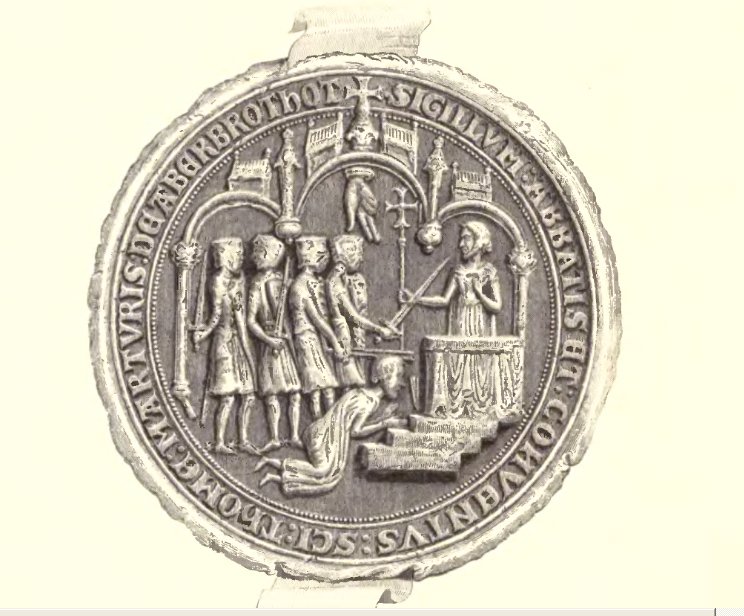
The Abbey itself is in ruins although its dedication to Thomas Becket, Saint and Martyr, is acknowledged within the town. Scots king William I, the Lion, had met Becket while a prisoner in England.
 
We practiced while the Una Voce members set up the altar and surrounds. It is such a blessing to return the Mass to these pre-Protestant sites, reclaiming Scotland's heritage. The Picts of the area around modern Arbroath probably heard the Mass in Latin in the 400s if not earlier.
The Abbey was founded in 1178 by William I for the Benedictines and the King was buried before the High Altar in 1214.

As Mass began, we sang the Introit 'Caritas Dei' and were a bit hesitant to start, although we picked-up towards the end. Next came the Kyrie of Missa de Angelis. And we stumbled as we heard a strong voice from the congregation, leading us at a slower pace and key (we had practised singing quietly to benefit from the acoustics). Alan reacted by drawing us in and we set off again to finish the Kyrie in good form, leading and drowning out any opposition.
We were spared congregational contributions for the Alleluia and the Sequence. I hope to put a recording of this on YouTube.
After Mass, Malky and I had lunch at the harbour before heading south.
We bought Smokies and dressed crab before leaving Arbroath.
One of us stayed awake for the entire journey home.


Friday, 24 May 2013

Doves

At our parish study-night last Wednesday, we looked at episode six of the Catholicism series.
Fr Barron uses the mosaic from San Clemente in Rome to describe the connection between Christ and His Church as Mystical Body.
I showed this detailed image from San Clemente, the Apostles are portrayed as doves

And this fantastic photo of Pope Francis
Click to enlarge images


The Spirit blows where He will

Alan had brought a new opening prayer for us, an extract from Psalm 70.
Repleatur os meum laude tua ut possim cantare; gaudebunt labia mea dum cantavero tibi. 
(Fill me with praise that I might sing. My lips rejoice when I sing to You.)
O Lord our God, through the intercession of the saints, Pius, Gregory, and Cecilia, grant us in thy mercy that through the praises we offer thee during our pilgrimage here on Earth, we may be found worthy to sing to Thee forever in heaven. In Christ our Lord, Amen"

Here's a clip from the Boston Archdiocesan Choir School, where they use Repleatur os meum laude tua as their motto. You can hear the start of the chant before the promotional video gets going.
http://www.bostonboychoir.org/about-the-school/welcome/

After the prayer, I  said that we had received an invitation to sing the parts of the Mass at an Ordinariate Mass in Edinburgh on Sunday 23 June, we agreed that some of us would try to go.

The practice got underway with the Introit for Saturday's Mass in Arbroath. Alan felt that we were mumbling a bit and had us all practice with round mouths, remembering the apple of sound. We were much better third-time around.

I took the chance to show off my knowledge of trivia. Did you know that the Pope to whom the Declaration of Arbroath was addressed was John XXII?

The document opens ' To the most Holy Father and Lord in Christ, the Lord John, by divine providence Supreme Pontiff of the Holy Roman and Universal Church'.

The same John XXII wrote the hymn Soul of my Saviour

    Anima Christi, sanctifica me.
    Corpus Christi, salva me.
    Sanguis Christi, inebria me.
    Aqua lateris Christi, lava me.
    Passio Christi, conforta me.
    O bone Jesu, exaudi me.
    Intra tua vulnera absconde me.
    Ne permittas me separari a te.
    Ab hoste maligno defende me.
    In hora mortis meae voca me.
    Et iube me venire ad te,
    Ut cum Sanctis tuis laudem te.
    In saecula saeculorum.
    Amen


Hear Vatican Radio on both and John XXIII here:
http://media01.radiovaticana.va/audiomp3/00360235.MP3
Six minutes well spent in my view.
And its 'Wash me ye waters' according to my boys own book of Latin grammer, not 'wash me WITH waters' as it reads in current hymnals.

The highlight of our session was a unanimous vote that Malky should get an honourable mention on the blog for spotting the two small diamond-shaped dots in the Communion Hymn at 'vult'. I can't find a version of the text on-line but it reads:
Spiritus ubi vult spirat, et vocem ejus audis, sed nescis unde veniat, aut quo vadat
The Spirit breatheth where he will; and thou hearest his voice, but thou knowest not whence he cometh, and whither he goeth (John 8:3 )

We all thought that they were misprints.
Alan was delighted to tell us that these were liquescents and that the l in vult should be hummed.
Well done Malky
For Malky
The Spirit blows where He will
Amusing montage here


Saturday, 18 May 2013

Veni Sancte Spiritus

Four of us met in the church. There were three apologies.
We spent time on the Pentecost Octave Mass for 25th May. The Introit is harder than it looks; one breath for per inhabitan temSpiritum eYjus in nohhohbis.
Click to Enlarge

And remember to soften at the end of each phrase. And emphasise ALLeluia at the start.

I posted a version of the Pentecost Sequence, Veni Sancte Spiritus. Alan's approach to this is different from those recordings.
Imagine a Tambour and one of those droney Mediaeval horn instruments, a bit like this:

I found myself beating time like a drummer as we sang to the Holy Spirit:
VENI, Sancte Spiritus,
et emitte caelitus
lucis tuae radium. 

Holy Spirit, Lord of Light, From the clear celestial height. Thy pure beaming radiance give.
Come, thou Father of the poor, Come, with treasures which endure; Come, thou Light of all that live!
Thou, of all consolers best, Thou, the soul's delightful guest, Dost refreshing peace bestow.
Thou in toil art comfort sweet; Pleasant coolness in the heat; Solace in the midst of woe.
Light immortal, Light divine, Visit thou these hearts of thine, And our inmost being fill.
If thou take thy grace away, Nothing pure in man will stay; All his good is turned to ill.
Heal our wounds, our strength renew; On our dryness pour thy dew, Wash the stains of guilt away.
Bend the stubborn heart and will; Melt the frozen, warm the chill; Guide the steps that go astray.
Thou, on us who evermore Thee confess and thee adore, With thy sevenfold gifts descend.
Give us comfort when we die; Give us life with thee on high; Give us joys that never end.
Amen. Alleluia.


I am reading at the Pentecost Mass
Thou, of all consolers best, Thou, the soul's delightful guest, Dost refreshing peace bestow.

Alan described the cadences of the Offertory as a leaf drifting down on a still autumn morning. Delicate.


Thursday, 16 May 2013

Back from Hols

Our holiday in Milan/Sicily was a success. I can now claim to have sung in La Scala Milan.
We went to the Museum and were able to get into a box in the empty theatre

We went to Mass in the Duomo of Syracusa. Newly cleaned and gleaming.
I had the readings etc on my I-Pod so we could follow along. The music was provided by an organist and a lady singer with a microphone in hand. It is said that having a 'cantor' with a mike deters congregational singing and that certainly happened here. After the final blessing, the music began for Regina Caeli.
I joined in, newly confident in my chant skills. That doubled the number of people singing.

Other engagements had kept members away from the Latin Mass in Holy Spirit. Apparently we were missed.
Practices had continued while I was away, so when I joined the group they were already coming to grips with the planned Vespers for August.

We began with the Choiristers Prayer then went into the Mass planned for 25th May - Holy Mass of Ember Saturday in the Octave of Pentecost.
Here is a version of the Introit, with lecture notes and tips in Italian:

This is in Mode3 - Tantum Ergo. Alan had us emphasising the ALLeluia and watching out for the doubled notes as in Spiiritum as well as the triple effect on Sanctohohoh in the Gloria.

Stephen Langton (1150-1228) is credited with Venite Sancte Spiritus, its earliest form is to a drumbeat timing. We sang it with much more percussion than this:

While we were in Sicily, we saw the original of the Year of Faith poster image at the back of the church.

It is in the Cathedral at Cefalu. The image shows Christ Pantokrator. The two wisps of hair suggest humanity and divinity. He wears gold signifying divinity and has taken on the cloak of humanity (blue). He wears the stole as High Priest. There are many more theologically important features of these images. Our fore-fathers could 'read' such pictures.
 Click to Enlarge
Mary his mother wears blue, the colour of humanity but she has a cloak with specks of gold. 

 Here's a third-party photo showing the two together, tripods were banned so I couldn't get this shot

Sunday, 21 April 2013

I heard the Mass was beautiful....

Our Thursday practice was in the crying room at St Margaret’s, although we went into the back of the church to hear the reverberations at the end.
Alan had produced booklets for the Saturday Mass, some for us and several for the congregation.

Our practice began with Alan introducing the Introit hymn 'Salve sancta Parens'. A new prayer for us all. But we cracked-on.

 There are simple English language  Introits for each Mass. I wonder if Parishes might sing these Introits each day as implied in the Missal and Canon Law, rather than substituting an 'opening hymn'. But that's never going to happen because we are all so happy to sing together.

Father Joe recites the Introit at dailiy Mass. Perhaps we the people could offer to sing it instead?
Perhaps we could propose chanting the Introit after or before the 'opening hymn' on Sundays?

There are several English settings for the Introits such as these:
 http://www.chantcafe.com/2012/12/hymn-tune-introits-at-daily-mass.html


We thought that we were ready for the Mass of the Blessed Virgin 'In Sabbato' at Cambuskenneth on Saturday. Apart from the Alleluias. In the end we gave up on these.

Our team arrived early and Jack noted that I had brought 'our strip'.

We didn't look too bad (although those attending will know a small secret about one of us and our cassocks).
The schola had to stand in the doorway  for enough light to see our square dots and Latin words.
George and I were outside the doorway.
We two couldn't hear the full 'chant-effect' but apparently it was very moving.
Our Catechist Leader in St Margaret's rushed by this morning and said  'I heard the Mass was beautiful'.

Our next Thursday rehearsals will be the Vespers settings in anticipation of praying in the Holy Rude and the Chapel Royal..
I will not be there, rather I will be in Sicily on hols.

Next steps, prep for Vespers and agree a date with Fr Joe to sing Kyrie and another Mass prayer at our regular 11.00 Sunday Mass.