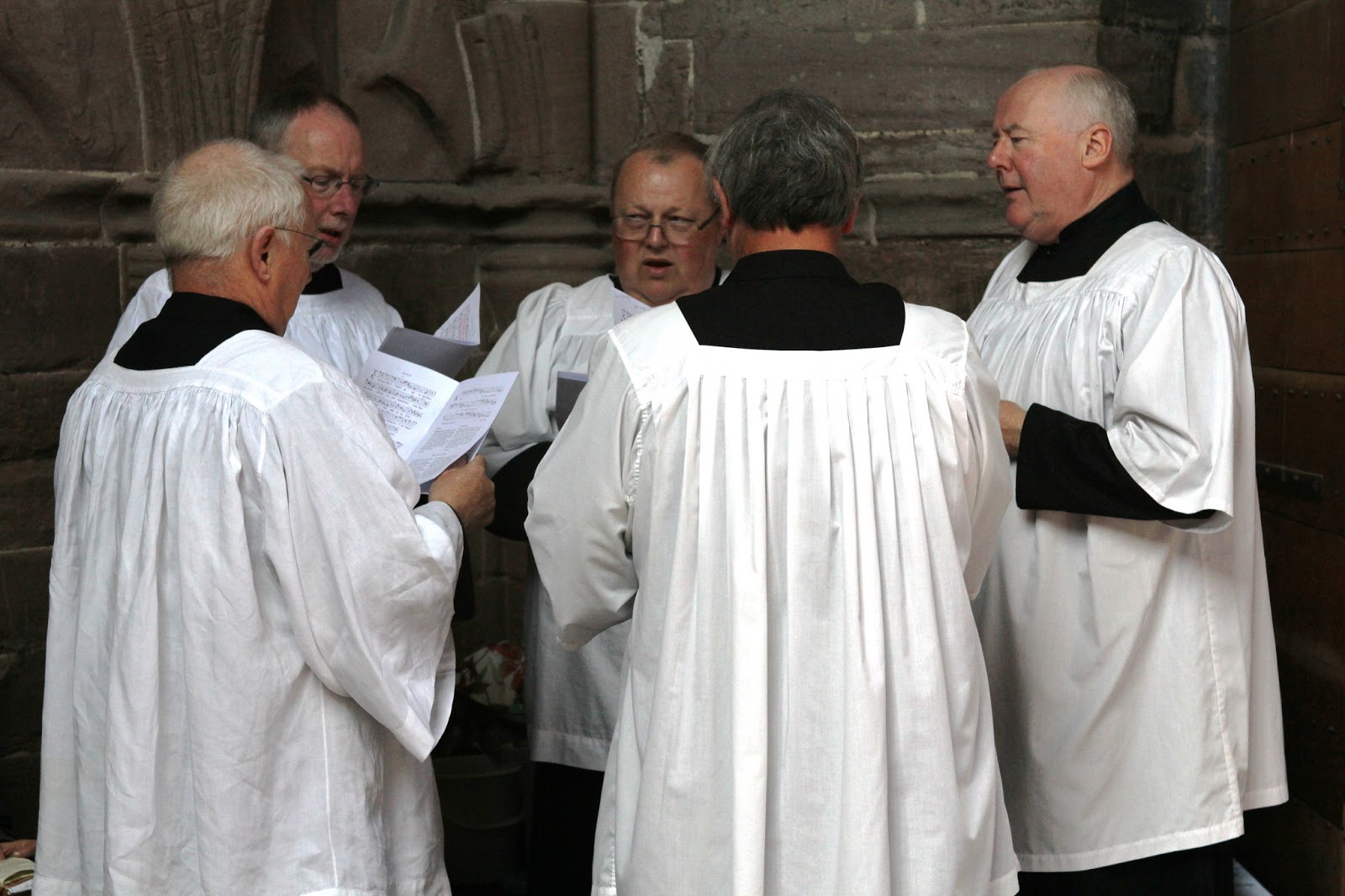
The second antiphon for the Fourth Sunday in Advent follows:
Ecce veniet desideratus cunctis gentibus: et replebitur gloria domus Domini, alleluia.
Lo! the Desired of all nations will come: and the house of
the Lord shall be filled with glory, alleluia.
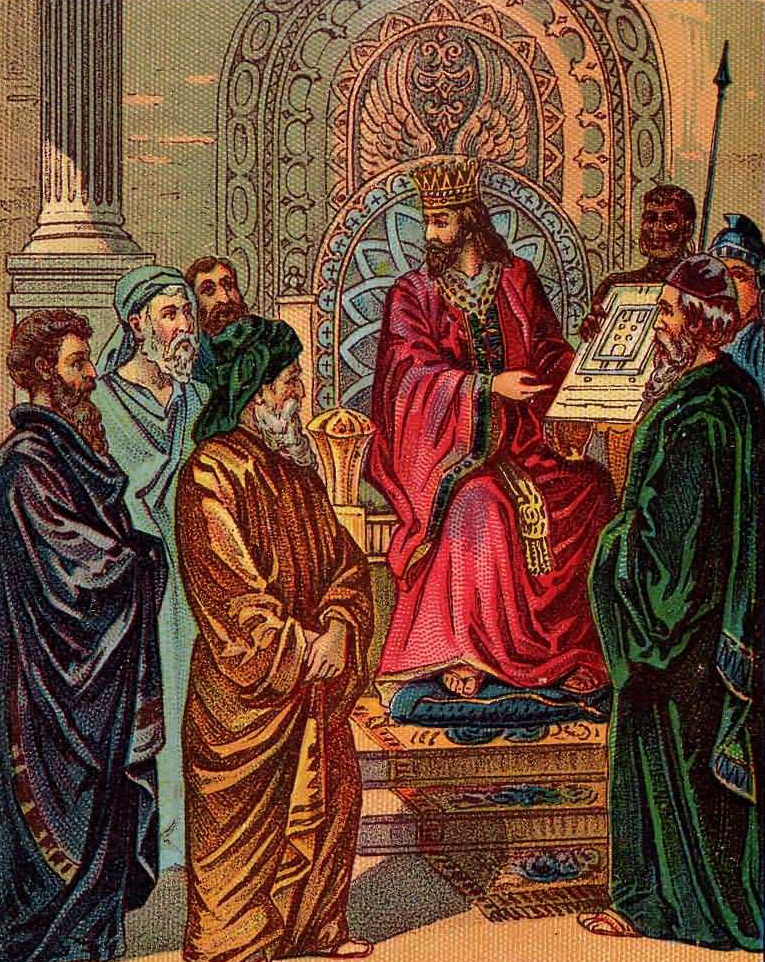
The antiphon is based on Haggai 2:8, with the speaker changed from
God to the monks:
"And I will move all nations: AND THE DESIRED OF ALL NATIONS
SHALL COME: and I will fill this house with glory: saith the Lord of hosts".
There is an interesting discussion of the translation on the
blog of an American Benedictine who notes that the key word here is desideratus
and that the Vulgate follows more closely the Hebrew than the Septuagint Greek
in rendering the Hebrew chemddah, (delight, desire).
“Normally, this is understood as a prophecy of 'precious
things' or 'treasure' pouring into the temple, and this is corroborated in this
same verse of Haggai by references to silver and gold, which are obviously
things desired and delightful for those who own them.
In the context of the Advent liturgy, with its emphasis on
the world's longing to be redeemed from the slavery of sin and death, and the
theme of the opening of salvation to the Gentiles, this antiphon is now
referring to Jesus Christ as the One longed-for by all nations.”
Vespers began with Father Andrew chanting 'Deus in adjutorium
meum intende' (O God come to my aid) and everyone answers 'Domine, ad adjuvandum
me festina'. (O Lord, make haste to help me). This is based on Psalm 70:2 and
was originally introduced at the start of prayer in the west by John Cassian in the fourth
century. Saint Benedict had used Cassian’s prayer at the start of most offices
and for tasks such as weekly service in the kitchen.
See Kevin Peterson's blogpost at Compline Underground
We sang Advent Vespers in St Mary's church in Stirling. Father Andrew Kingham officiated
We started the Processional Hymn in the doorway from the
vestry so it sounded distant and had little reverberation from the
surroundings.
This was quite effective in communicating that we were
coming from a distance.
Then we began to enter the nave and by the end of verse 2 the
reverberations sounded better, as you can hear.
By verse three the building was making us sound like chant
experts.
Those Pugin boys really knew how to build churches with great acoustics for Chant.
We processed to the back of the church by way of the north
aisle, then up towards the Altar along the centre aisle. Our voices hardly
changed until we walked past the hand-held phone microphone at verse seven,
when you can hear our individual voices as we rustled by.
We sang the final Gaude in front of the Altar, before
ascending to our places, bowing first to the Tabernacle and then to each other,
after we had climbed the Sanctuary stairs in twos.
Veni, Veni, Emmanuel
The hymn is the Latin original of Oh Come, Oh Come Emmanuel and
lists the seven 'O Antiphons’ used in the days before Christmas. The congregational
Booklet had both the Latin text and the translation of the hymn and described
the ancient origin of the O Antiphons. These dated from the earliest centuries
of the Catholic Faith.
The congregational Booklet also explained that the first
letter of each Antiphon spelled the Latin for 'Tomorrow I will come' (Ero Cras).
Clever, these long-ago Benedictines who arranged the verses
so.
December 23: O Emmanuel
(O God who is with us)
December 22: O Rex
Gentium (O King of the nations)
December 21: O Oriens
(O Dayspring)
December 20: O Clavis
David (O Key of David)
December
19: O Radix Jesse
(O Root of Jesse)
December
18: O Adonai (O
Lord)
December
17: O Sapientia (O
Wisdom)
O come, Thou Wisdom from on high, And order all things, far and nigh;
To us the path of knowledge show, And cause us in her ways to go.
Rejoice! Rejoice! Emmanuel; Shall come to thee, O Israel.
O come, Adonai, Lord of might; Who to Thy tribes, on Sinai's height,
In ancient times didst give the law, In cloud and majesty and awe.
Rejoice ! Rejoice ! Emmanuel; Shall come to thee, O Israel.
O come, Thou Rod of Jesse, free, Thine own from Satan's
tyranny;
From depths of hell Thy people save, And give them victory
o'er the grave.
Rejoice ! Rejoice ! Emmanuel; Shall come to thee, O Israel.
O come, Thou Key of David come; And open wide our heav'nly home ;
Make safe the way that leads on high, And close the path to misery.
Rejoice ! Rejoice ! Emmanuel; Shall come to thee, O Israel.
O come, Thou Dayspring, from on high,
And cheer us by Thy
drawing nigh;
Disperse the gloomy clouds of night, And death's dark
shadows put to flight.
Rejoice ! Rejoice ! Emmanuel; Shall come to thee, O Israel.
O come, Desire of nations, bind, All peoples in one heart
and mind;
Bid envy, strife and quarrels cease; Fill the whole world
with heaven’s peace.
Rejoice! Rejoice! Emmanuel; Shall come to thee, O Israel.
O come, O come, Emmanuel, And ransom captive Israel,
That mourns in lonely exile here, Until the Son of God appear.
Rejoice! Rejoice! Emmanuel; Shall come to thee, O Israel.
The annual Una Voce Mass at The Abbey of St. Mary of
Cambuskenneth was held on the 18th October. Our Schola had assumed
that this was to be the same as the regular Missa de Angelis we pray at the
monthly 5.00pm Latin Mass in Holy Spirit church.
But them Alan explained that the Mass was to be for the
Feast of Saint Luke. So we had to have an online rehearsal using this expert: http://www.youtube.com/watch?v=W_Dn8IC7bag
Here is another version
We also had an early practice meeting which had visiting tourists standing
outside and saying how much they enjoyed our singing. We milled about after our practice:
Despite my forgetting to list the Mass in Stirling’s
local Parish bulletins, the Tower was full of worshipers. Refreshingly, most
were younger than me, there was even an impatient toddler.
Here is the Altar before Mass:
I had invited the CountyArchaeologist
who had expressed an interest after accompanying me on my ‘Catholic Stirling’
tour. I gave him a Missal with the Latin and English texts for the
Mass and marked the passages for St Luke, as well as the translation of Adoro
te Devote. But when I looked over to see how he was faring, he had closed the Missal
and was just watching and listening. I later apologised to him that I had been
a very poor host, leaving him alone while I joined the Schola. He countered
that he had enjoyed the Mass and had ‘lost himself’ in the occasion.
AcoLight?
When I was a young altar boy we learned the basic Latin prayers
and where to stand, kneel etc.
Then I was promoted to Acolyte. This involved
carrying one of the two candles when the priest read the Gospel. As a boy, I
saw this as a symbolic action to light the Bible so that it could be read by
the Priest. I was sure that the name Acolyte had something to do with providing lyte.
Now that I am become a man, I have put away childish things … so I know that akolouthos
means an attendant. But deep down, I still think that it refers to the guys with the
candles who give light.
These days, this task can be accomplished using the 'assistive light' function
on a smart-phone, as Martin demonstrates. Father Emerson can read the Epistle despite the gloomy interior of the Tower:
Martin even invented a solemn rubric as he transferred the smart-phone to the Gospel side, moving the longer way and bowing before ascending to the Altar, where he joined the server in the responses. All very dignified, Lex Credendi and all that.
The Schola's voices sounded strong and united as the old stones echoed to our chant.
The
Mass commemorated
the founding benefactors of the Chaplaincy, Canon John Gray,
Marc-André
Sebastien Raffalovich, and Mrs Charlotte Jefferson-Tytus. with
a sung Requiem
in the Dominican rite.Mass
was
celebrated by Fr Lawrence Lew who writes:
“Last
Saturday’s Missa Cantata was
celebrated in this modern chapel, which has received seven
major architectural
awards so far. This was the first time the ancient rite of the
Order has been
said in it, and it was probably also the first public
Dominican rite Mass in
the city for almost five decades. Mass was sung by fr.
Lawrence Lew, O.P., who
is assistant Catholic chaplain at St Albert’s, and two
students of Edinburgh
University served as acolytes; the students had ably mastered
in just two days
the intricacies of this role in the Dominican rite. The sermon
was preached by
the Prior, fr. Dermot Morrin, O.P., in which he reflected on
Canon Gray’s
conversion to Catholicism having glimpsed the simple reverent
beauty of the
Mass, and Raffalovich’s love of beauty and the Dominican
charism.
ASchola Gregoriana comprised of
singers from
Stirling-based ‘Cantors of the Holy Rude’ sang the Mass
propers and ordinary
from the Dominican Gradual. They were led by an alumnus of
St Albert’s
Catholic Chaplaincy, James MacMillan
CBE”.
Alan
took the
opportunity to askJames
MacMillan
to be our Patron and he agreed.
Here we are led by our soon-to-be Patron (wearing suits rather than soutanes)
We are used to an Opening Hymn for the Entrance Procession into Mass.
Yet I had read that the Introit in the Missal is to be preferred over any other song. I had never understood how the short Antiphon in the Missal could be long enough to accompany the Entrance Procession. But now I know!
You sing the Entrance Antiphon and then the Psalm verses....
But this shouldn't have been such a mystery.
The 2011 General Instruction of the Roman Missal (GIRM) reads as follows:
"47. When the people are gathered, and as the Priest enters with the Deacon and ministers, the Entrance Chant begins. Its purpose is to open the celebration, foster the unity of those who have been gathered, introduce their thoughts to the mystery of the liturgical time or festivity, and accompany the procession of the Priest and ministers. 48. In Scotland: This chant is sung alternately by the
choir and the people or similarly by a cantor and the people, or
entirely by the people, or by the choir alone. In the dioceses of
Scotland the Entrance Chant may be chosen from among the following:the
antiphon with its Psalm from the Graduale Romanum or the Graduale
Simplex, or another chant that is suited to the sacred action, the day,
or the time of year,and whose text has been approved by the Conference
of Bishops of Scotland. If there is no singing at the Entrance, the antiphon given in the Missal is recited either by the faithful, or by some of them, or by a reader; otherwise, it is recited by the priest himself, who may even adapt it as an introductory explanation."
At the Mass after the Conference, we went with the option specified by the GIRM. The recording below was made on an iPod placed away from me. We were in the front row of the choir stalls on the right in the picture below. James MacMillan didn't know about my recorder and chose to stand directly in front of the device. He sounds much louder on the recording than in real life.
The congregation, including many who had participated in the Conference, is to the left out of the picture. We sang men's voices/women's voices rather than antiphonally. It was beautiful. Here is the video
Two speeches opened the event. James MacMillan was effusive and very positive and I felt that Archbishop Tartaglia gave a much better speech than the last one I had heard to welcome Archbishop Muller of the CDF. One of our number didn’t have the comparison and was not very impressed by His Grace’s technique. Nevertheless, the Archbishop strongly affirmed his desire that Gregorian Chant should be used in Catholic churches and noted that the poor should be exposed to the musical riches of the Church. He explained that his favourite hymn is Thomas Aquinas’ Adoro Te Devote.
Next Charles Cole rehearsed the music for the Mass. This was successful, apart from some details. A couple of people observed that Charles began in the wrong Mode but I didn't realise any of this. His approach to the pacing of Psalm verses was different from that of our teacher. James MacMillan helped out on this, emphasising the need to pause mid-verse at the *. And for the next verse to start quickly.
At 11.30 we had to choose from three options – 1. Releasing the Voice, 2. Introduction to chant notation or 3. Advanced Chant Class to be given by Father Guy Nicholls from the Birmingham Oratory. We chose Fr Guy, hoping that we could keep-up.
We could.
Father Guy began by taking us through the Gradual for the Saturday evening Vigil Mass, this replaces the Responsorial Psalm between the first and second readings:
CLICK TO ENLARGE ANY IMAGE
Dirigatur oratio mea sicut incensum in conspectu, Domine. Elevatio manuum mearum sacrificium vespertinum.
Let my prayer be directed as incense in Thy sight O Lord.
The lifting up of my hands, as evening sacrifice. (Psalm 141).
I recorded the session with my iPod in my shirt pocket, so it sounds very scratchy but I hope that you can hear that Fr Guy’s voice was not only excellent but very precise.
By way of introduction he told us that this Gradual was typical in that the Versicle was generally the solo part and was of a wider range, certainly a higher note is usually reached, as in Elevatio. And that words seem to trigger certain musical shapes or ideas. Thus, Elevatio, raising up, actually produces a raising-up of the voice. Words are painted with the music.
Our summer has been busy and I recorded so much music that it became an obstacle to blog about the events. So here’s a quick summary of our summer.
And autumn.
We were welcomed into the Church of the Holy Rude on 27th July where we sang Vespers and Compline of the Exaltation of the Holy Cross, surely the most appropriate Feast Day for the medieval building of the same dedication.
We were joined by the Schola Cantorum of St. Pancras who gave a splendid recital of polyphony. They use this inspiring image of a spiral staircase as their brand:
This was probably the first time that these verses had been prayed in that building since the 1560s.
August started with our listings in the Edinburgh Festival Fringe. On the 3rd we prayed Vespers of the Transfiguration of the Lord Jesus Christ, Mgr Michael Regan was the Celebrant.
Six of us with Mgr Regan afterwards
Click any Image to Enlarge
On Sunday, we sang the parts of the Missa de Angelis at the 11.00 parish Mass in St Margaret’s in less-than-perfect circumstances. Delays meant that we didn’t have time to rehearse with the congregation. That evening we formed the schola for the 5pm Traditional Latin Mass in the Holy Spirit church. I served at the altar but the group sounded very good without me.
The next Saturday found us again in Edinburgh for Vespers of the Exaltation of the Holy Cross. This time Simon Nieminski had organised a choir to sing polyphony and we sang verse about. Again the Celebrant was Mgr Regan.
17th August saw our final Festival 2013 appearance, this time we prayed second vespers for the Feast of the Assumption. For some of the Psalms Simon Nieminski played versets by Jean Titelouze. Here, the organ took the place of the schola singing antiphonally. I have uploaded the Opening Versicles, the first Antiphon 'Assumpta est Maria in caelum'. Here we are before the organ verses start:
I'll upload the video when it appears on the main YouTube channel; click here to open it until then.
I travelled to Linlithgow on the 31st for a Diocesan Singing Day organised by Forth in Praise. This featured modern hymns and new Mass settings with a guitar workshop in the afternoon. Not being a guitarist, I made my excuses and left, as the News of the World used to say of its reporters. One of the hymns, Bernadette Farrell’s Bread For The World, was misprinted so as to be meaningless but we all sang along anyway:
"Lord Jesus Christ, you are the bread of life, broken to reach and heal the wounds of human pain, Where we divide your people waiting there on bended knee to wash our feet with endless care".
There’s a ‘You are’ missing before the ‘waiting’ I think. Even then, from a theological point of view, I'm not too sure that we should be telling Our Lord that He should be found kneeling before us to wash our feet.
1st September saw us back at Holy Spirit for the Latin Mass. We sang Adoro Te Devote as the Communion Hymn. I was able to sing this time. Fr John Emerson was the Clebrant as usual.
Two members attended the National Pilgrimage at Carfin on the 8th, there was some Chant.
October started with us singing the Kyrie and Agnus Dei at morning Mass in St Mary’s Stirling. We had arranged an open-day for anyone interested in Chant and Fr Kenneth had agreed that we could use St Mary’s and Sion House. In the event there were transport problems from Glasgow and two groups couldn’t attend, Fred gave up as well. Those who came enjoyed themselves.
6th October had us back at Holy Spirit for the TLM, while on Saturday 26th we travelled to the Preceptory of the Knights of St. John in Torphichen for Mass. The Celebrant was Fr Mark Morris, with Fr Emerson in Choir.That's my crucifix above the Altar, with the Corpus my father cast in Ireland, not long before he joined the Royal Navy.
Several Knights of Malta, and one remarkable Dame, assisted at Mass.
We had planned a practice on Monday but Alan was laid low in Edinburgh. I thought of FaceTime and we arranged a link-up between his iPad and Morven's. It seemed to work when we tried it at 5.00pm so I phoned around and three of us met. We snuggled together at our dining table so that we could all be seen by the camera and after jokes about i-Cantors, we had a go. We began with the Vespers planned for 27th July. Things started badly and then got worse – the time-lag between Edinburgh and Stirling led us so badly astray that we began to sing less and less well. We called a halt. But not before Jack offered some medical advice on Diarrhoea, apparently the advice I had received from our old family doctor (clear liquids, lemonade etc) is now wrong. Drinking the salty water of boiled rice after eating the rice is the approved approach for serious Diarrhoea.
Next day we met in the Hall in the afternoon. While we were waiting for Alan, the others helped me with Deus, in adjutoriam (O God, come to my aid : O Lord, make haste to help me). Here it is until 1.08: http://www.youtube.com/watch?v=6vIfbtKHvk0
We worked through the Antiphons and Psalms of Vespers of the Exaltation of the Holy Cross O magnum pietatis opus: mors mortua tunc est, in ligno quando mortua vita fuit.
I noted that we were good with the fu-it.
O great work of love: death then was dead when on the Cross Life itself had died.
There appears to be no recording of this chant in mode VII on-line, so we can be first. DV.
We got more comfortable with the Psalms, then on the Vexilla Regis. Vexilla regis prodeunt, fulget crucis mysterium, quo carne carnis conditor suspensus est patibulo.
The banners of the king issue forth, the mystery of the cross does gleam,
where the creator of flesh, in the flesh, by the cross-bar is hung.
Jack spotted that there was a missing neume in our version of verse 7, this was causing us to miss-count and go wrong. We inked-it in and agreed that Jack deserved a special recognition:
The Antiphon O Crux benedicta has a very complicated alleluia:
Click Image to Enlarge
Alan took us through it is short steps. The al could end in a liquescent, then into the le----. This features a series of neumes, repeated twice, as you can see.
We had a quick scamper through Compline before heading-off to visit Holy Rude and arriving after they had closed for the day.
I missed the Mass in the Holy Spirit because I was in England at a wargames conference. This involved serious and light-hearted simulations, various talks and a sing-song. One fascinating talk was on CyberWars and the importance of the human factor.
The presenter was an ex-spook and observed that in a few years, over 40% of the world's population would live on the edge of the Indian Ocean or on rivers which flow into it. Their concern was access to water not energy.
My talk was on Catholic Specs. Here's a summary:
Catholic Specs
I'm a Christian. I'd like to suggest that you need to put on
Catholic Specs to see Western military history more clearly.
For most of our recorded history, Britain was Catholic. Yet our
military historians seem to have a blind-spot about this. They do not engage with the importance of belief in God during wars
of the past. But they are missing a key
factor.
I’d like to offer a couple of examples to show what I mean.
Bannockburn
Before the battle, there was a famous event when the Scots
were recorded as kneeling and the English king Edward observed this saying ‘Yon
folk are kneeling to ask mercy.’ He was advised that they asked God for mercy
for their sins, rather than from him.
People have argued that this was the moment when the Scots
knelt to be ‘shriven’ of their sins, or when Mass was said. Yet both armies
were Catholic; both armies attended Mass and both were ‘shriven’. There should
have been no observable differences between the religious practices of the two
Catholic armies facing each other.
My Catholic Specs would suggest that something extra was involved. Something that was specific to Scottish Catholicism at that time. I believe
that what was happening in 1314 was the veneration of Columba’s reliquary
(contained in the Brecbennoch) as
this was carried in front of the Scottish lines. Even today we Catholics would
genuflect at such a moment. However a lack of Catholic sensitivity has led to
an ignorance of the way a medieval Catholic army would respond to the ancient
relics of their saint being carried in front of them. There would have been a "Mexican-wave Genuflection" as the relics were carried along the front.
Victorian accounts
completely fail to see this and even Chris Brown’s recent account of the battle
ascribes this event to an imagined headcount and alignment exercise by sub-unit
commanders because he is looking for an earthly explanation.
While Brown’s account of the battle is the most accurate
available, he rejects my proposal that the soldiers knelt as the relics were
carried before them because he hasn’t got Catholic Specs.
The Monymusk Reliquary
The Crusades
There is a famous D-Day monument named ‘The Crusader Sword’
on Juno Beach at Courseulles-sur-Mer. This
suggests that the people of the time saw that the Crusades were an attempt to
liberate an oppressed population, as was D-Day.
'Crusader Sword' - Courseulles-sur-Mer
I would argue that the Crusades prefigure the Allied
liberation of France
in several ways. A western force travelled east to liberate a people oppressed by a
recent invader; many innocent civilian casualties were incurred (50,000 French
civilian casualties from the Allied bombing of Normandy/unknown thousands
massacred after the siege of Jerusalem, 3,000 to 40,000 depending on source);
crimes against the existing rules of war were committed (execution of SS
prisoners of war/massacres in captured towns beyond the first day); long-term
military influence was secured (NATO/The Crusader Kingdoms) and earthly power
was enhanced (Eisenhower’s Presidency/Urban’s Papacy).
There were several military ventures which we know as
Crusades.These included actions against
heretics as well as against Muslim-held territory in the West, such as the Reconquista
(Retaking) of Spain and also
against Muslim pirates and slavers from North Africa.These 'Barbary Corsairs' attacked coastal
settlements in Christian Europe, taking well over a million people into slavery
between 1530 and 1780, including the entire population of Baltimore
in County Cork captured and sold into slavery in
1631. Their piracy and slave-trading only stopped in 1830, following a French
invasion.
I’m going to look at the First Crusade, since this initiated
the response and was the only Christian success in 300 years of attempting to
hold the advance of Muslim armies in the Holy Land.
In the summer of 1096 between 60,000 and 100,000 Catholics
set out to walk from western Europe to the Holy Land.These were men and women drawn from all
sections of society, travelling on an armed pilgrimage to liberate the Holy
Places, in particular Jerusalem.
They were responding to the call of Pope Urban II at the Council of Clermont in
1095 yet there had been centuries of broadly peaceful co-existence between
Muslims and Christians.
The co-existence between Muslim rulers and Christian
subjects and pilgrims had continued under the Fatmid Caliphate but was
disrupted when the Holy Land was invaded by
the Seljuk Turks. The Seljuks instituted a pogrom against Christians and
restricted their movement. Pilgrimages became both more difficult and more
dangerous. They confiscated Christian property, burned crosses, destroyed
churches and built mosques on their sites. ‘By 1014 over 30,000 churches had
been destroyed or pillaged’.This
created an atmosphere of collective outrage in Europe which Vidmar compares to
that following the Japanese attack on Pearl Harbour
or the destruction of the World Trade Centre in 2001.
The Seljuks captured Jerusalem
from the Fatmids in 1071 and Alexius I, the Emperor of the Eastern
Roman Empire, appealed to western Christians for help. Pope Urban
called the Council of Clermont as a response. There are six accounts of Urban’s
speech but all share the same key message ‘to carry aid to the lands of our
friends and to destroy that vile race from the lands of our friends’. We shouldn’t be misled by recent movies which
portray these volunteers as evil, rapacious invaders intent on destroying a
peaceful Muslim earthly paradise.
These Pilgrims saw themselves on an errand of mercy which,
although initially successful ended in failure and defeat by the Seljuks.
Indeed, the Fourth Crusade (1201-1204) was so badly organised that it was
diverted by the Venetians and led to the sacking of Constantinople.
This was strongly condemned by Pope Innocent III yet is still cited by many
Eastern Orthodox Christians as a major obstacle to reunion with the Catholic
Church.
The Crusades were seen as a military intervention to protect
the weak from an aggressive invader. I would argue that the First Crusade was
no less moral than the Allied invasion of Normandy, indeed there are striking
similarities. The Allied Commander, Dwight D. Eisenhower issued a famous letter
to the troops who were about to undertake Operation Overlord in 1944. It
begins, ‘You are about to embark upon the Great Crusade’ and sets out the aim,
‘you will bring about the destruction of the German war machine, the
elimination of Nazi tyranny over the oppressed peoples of Europe, and security
for ourselves in a free world.’Eisenhower concludes with a prayer, ‘And let us beseech the blessing of
Almighty God upon this great and noble undertaking’.
Click to Enlarge
I would suggest that military historian's engagement with Christian
Europe is weakened by ignoring the high religious motivation which saw the
first-sons and best of European Christendom mortgaging their estates so that
they could aid fellow-Christians who were under the attack of Suljik Muslims.
And by ignoring the Christian men who struggled up the Normandy beaches during Operation Overlord praying ‘Over Lord….Over
Lord’.
Lepanto
The forces of Catholic Europe engaged a huge Muslim fleet
under very disadvantageous circumstances. The Pope had asked for Rosaries to be
said for Victory.
Later, he had a vision of a victory and ordered that the
bells of Rome
be rung.
This turned out to be at the very time of that victory……many
days before news arrived from the Fleet Commander.
A very public demonstration and open to ridicule if he was
wrong.
He wasn’t.
Here’s the start of Chesterton’s poem Lepanto:
White founts falling in the Courts
of the sun,
And the Soldan of Byzantium is smiling as they run;
There is laughter like the fountains in that face of
all men feared,
It stirs the forest darkness, the darkness of his
beard;
It curls the blood-red crescent, the crescent of his
lips;
For the inmost sea of all the earth is shaken with his
ships.
They have dared the white republics up the capes of Italy,
They have dashed the Adriatic
round the Lion of the Sea,
And the Pope has cast his arms abroad for agony and
loss,
And called the kings of Christendom for swords about
the Cross.
The cold queen of England
is looking in the glass;
The shadow of the Valois is yawning at the Mass;
From evening isles fantastical rings faint the Spanish
gun,
And the Lord upon the Golden Horn
is laughing in the sun.
Alan suggested that we might practice the Vespers at home to get used to the text.
I looked on YouTube.
The only recordings of the Vespers of the Assumption I could find are from the two guys I posted last week. But they are not singing Mode VII. Worth watching to see that there are slight differences from the gestures Alan described. And to highlight the need to practice gestures, so as not to detract from the prayerful dignity:
It is a very good effort and we can learn a lot from the Schola of the Hofburgkapelle Vienna.
I can report that the Ladies Group's 'fish tea' in the hall was a big success as was the ice cream, served with old-fashioned Oysters and 'nugget wafers':
All of the ice cream was scoffed (Fr Joe helped, apparently) so we would have got short shrift if we had gone over and asked for some, as I had suggested.
Did you know that 'shrift' derives from shriven and a short shrift implies a short Confession?
I didn't. But "any fule knos" as Jennings would have it.
We practiced for the Mass in Seton Collegiate Church, unfortunatley George told me before the practice that he would be leaving the group. We will miss his dignified presence.
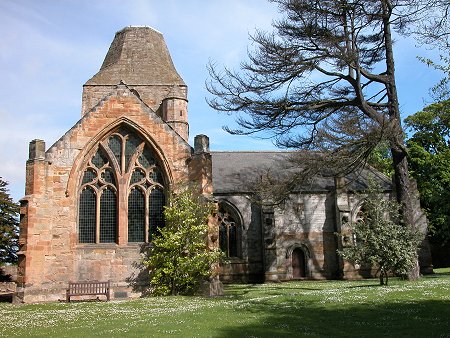
Malkie and I drove to East Lothian together. The lady from Historic Scotland was very enthusiastic about 'her' church and took us on a guided tour, showing us the Green Man and the Murdered Apprentice carved on the base of the corbels. Here's the Murdered Apprentice:
The acoustics were very forgiving as we sang the Mass of the Blessed
Virgin 'In Sabbato' in the church which was originally dedicated to 'Our
Lady and the Holy Cross'.
Several passers-by came in and some took places among the congregation. Others hung back and listened.
Here’s a first attempt at a YouTube video based on the audio recording of us singing the Introit hymn, Salve sancta Parens. The iPod recording is surprisingly good:
Salve, sancta parens, enixa puerpera Regem: qui caelum terramque regit in saecula saeculorum. Sentiant omnes tuum adiuvamen, quicumque celebrant tuam commemorationem.
Hail, holy mother, who did bring forth the King who rules heaven and earth for ever and ever.
May all who keep thy commemoration feel now thy help and protection.
I was careless and my photographs didn't turn out well, maybe next
time I'll remember to check settings before taking pictures on
automatic. But we sound pretty good - as my wife said 'Is that you?'
Before a fuller post, I though that it would be worth sharing a finding from our last session about Thomas Aquinas' great Eucharistic hymn,. Tantum Ergo. Tantum ergo Sacramentum Veneremur cernui: Et antiquum documentum Novo cedat ritui: Praestet fides supplementum Sensuum defectui. Genitori, Genitoque Laus et jubilatio, Salus, honor, virtus quoque Sit et benedictio: Procedenti ab utroque Compar sit laudatio.
I particularly enjoy the enthusiastic shouts of 'Gie it laldie' from 1.20 with 'Gie it laldie in the Raploch. This is a Papist stronghold' from 5.50. Fast Forward if you prefer.
We practiced this new-to-us Mass setting, Mass XI. We weren't very good but it is worth persevering with it because it comes from the earliest, most traditional years of chant.
Father Ray Blake writes about the Kyrie in Orbis Factor. Here we see the certainty of Divine mercy.
"The word eleison has a connection with olive oil, the sinuous melody seems to be like thick olive oil penetrating into the soul, healing and cleansing. The rise on the last syllable of Christe seems to be about a drenching in the oil of mercy". http://marymagdalen.blogspot.co.uk/2008/11/orbis-factor.html
This version of the Kyrie with 'tropes' is pretty remarkable:
1. Orbis factor rex aeterne, eleison
2. Pietatis fons immense, eleison
3. Noxas omnes nostras pelle, eleison
4. Christe qui lux es mundi dator vitae, eleison
5. Arte laesos daemonis intuere, eleison
6. Conservans te credentes confirmansque, eleison
7. Patrem tuum teque flamen utrorumque, eleison
8. Deum scimus unum atque trinum esse, eleison
9. Clemens nobis adsis paraclite ut vivamus in te, eleison.
1. Maker of the world, King eternal, have mercy upon us.
2. O immense source of pity, have mercy upon us.
3. Drive off all our evils, have mercy upon us.
4. Christ who art the light of the world and giver of life, have mercy upon us.
5. Consider the wounds produced by the devil's art, have mercy upon us.
6. Keeping and confirming thy believers, have mercy upon us.
7. Thou and thy Father, an equal light, have mercy upon us.
8. We know that God is one and three, have mercy upon us.
9. Thou, merciful unto us, art present with the Holy Spirit that we might live in thee, have mercy upon us.
(from Wikipedia)
We are aiming for this:
Father Blake writes that one of the nice things about the Traditional Rite is that the Penitential Rite and absolution is a private affair, for the priest and server at the foot of the altar, a preparation for Mass
"so the Kyrie becomes a triumphant proclamation in which the Christian prays and as he prays, he receives. The priest might mutter about his sinfulness under his breath but in the "congregation of the Redeemed" he and the congregation proclaims God's mercy".
He writes that the priest's introduction to the Penitential rite in the modern Mass, using his own words, "can become downright tedious, almost Pelagian". On regular Sundays we stand and pray the Confiteor together.
When I serve at the Latin Mass, I bow low while on my knees at the foot of the Altar and confess my sins, on behalf of the rest of the congregation. I am older than these chaps and always comb my hair:
The Ladies Group were in the Hall, hosting an event for seventy female guests from other parishes. They had tables set out and meals ready to go. Dancing was planned.....
We met in the crying room in the church. George was back with us after
his surgery and ready to punch people with his newly strengthened fist.
Jack stuck up for the NHS.
Alan wanted us to practice a new Mass setting AND the Vespers for Edinburgh.
I thought that he was being a bit optimistic.
The new Mass setting was Missa Orbis Factor. The name comes from the opening of the extended Kyrie which opens with a 'trope': Orbis factor rex aeterne, eleison
Maker of the world, King eternal, have mercy upon us.
I
will write more on Orbis Factor later. Suffice it to say that we were
not very good. The basic Kyrie is to be 'flowing', with counts of
222,333 for the start of the Kyrie and 333, 333 for the start of the
Christe. We sang our way through the other prayers. It will be several
more weeks before we try this Mass in public.
The Vespers went a bit better. We have until August to get this right. I will find a local venue for a practice in July.
The couplets from the Psalms are sung with a pause. Vespers sound something like this
Although these guys go up at the end of each line in the second part (Psalm 112) and the square notes don't appear to.
The final hymn began O Prima Virgo Prodita. This doesn't mean O Best Protestant Virgin.
O prima, Virgo, pródita E Conditóris spíritu, Prædestináta Altíssimi Gestáre in alvo Fílium; Tu perpes hostis fémina Prænuntiáta dæmonis, Oppléris una grátia Intamináta orígine.
O Virgin thou, the spirit's fair’st,
Predestined by the will divine,
Within thy sacred womb thou bear’st
His only Son, and also thine.
O thou in whom rich grace abounds,
Foretold thou wast to be the foe
Who in her origin confounds
The wicked demon here below.
Look at the crisp line on my sleeve - there's an excellent ironer in the group.
Here's the text to follow as we sing the prayer (The Sequence starts at 2.05, after the Alleluia).
Click to enlarge
Here it is in English (although this translation of Veni Sancte Spiritus from the Missal doesn't start 'Come Holy Spirit'):
Holy Spirit, Lord of Light,
From the clear celestial height.
Thy pure beaming radiance give.
Come, thou Father of the poor,
Come, with treasures which endure;
Come, thou Light of all that live!
Thou, of all consolers best,
Thou, the soul's delightful guest,
Dost refreshing peace bestow.
Thou in toil art comfort sweet;
Pleasant coolness in the heat;
Solace in the midst of woe.
Light immortal, Light divine,
Visit thou these hearts of thine,
And our inmost being fill.
If thou take thy grace away,
Nothing pure in man will stay;
All his good is turned to ill.
Heal our wounds, our strength renew;
On our dryness pour thy dew,
Wash the stains of guilt away.
Bend the stubborn heart and will;
Melt the frozen, warm the chill;
Guide the steps that go astray.
Thou, on us who evermore
Thee confess and thee adore,
With thy sevenfold gifts descend.
Give us comfort when we die;
Give us life with thee on high;
Give us joys that never end.
Amen. Alleluia.
Maybe there should be a Glasgow version of the video uploading site called YaTube Ye.
We had practiced the Sequence Lauda Sion on Thursday for the Sunday Mass at Holy Spirit. The Mass was well attended
The gifts of the Holy Spirit are written on the stained glass window: sapientia, intellectus, consilium, fortitudo, scientia, pietas, timor Domini (wisdom, understanding, counsel, fortitude, knowledge, piety, fear of the Lord).
Two servers arrived, so I could sing with the Schola.
We are sounding more confident, according to my son.
In
the Kyrie we remembered to sing Chreestay and our pacing in the Gloria
was good. In our run-through before Mass, we had been too loud at the
endings and had the emphasis in Deus as De-us, rather than Deyus. But we
were fine at the Mass itself.
Lauda Sion is one of Aquinas's great Eucharistic hymns.
At the Communion, we sang one of his greatest hits Tantum Ergo.
Here's a short musical description of Thomas Aquinas's life and work sung to "Venus" by Bananarama. http://www.youtube.com/watch?v=m57m0XiRgBA
Worth clicking. 'Scholasticism was his game'.
Now, the Sequence itself:
We sang the Sequence well but we should have provided an English translation for everyone, not all have Missals with Latin/English. Here it is if you want to follow along:
Sing forth, O Sion, sweetly sing
The praises of thy Shepherd-King,
In hymns and caticles divine;
Dare all thou canst, thou hast no song
Worthy his praises to prolong,
So far surpassing powers like thine.
To-day no theme of common praise
Forms the sweet burden of thy lays –
The living, life-dispensing food –
That food which at the sacred board
Unto the brethren twelve our Lord
His parting legacy bestowed.
Then be the anthem clear and strong,
Thy fullest note, thy sweetest song,
The very music of the breast:
For now shines forth the day sublime
That brings remembrance of the time
When Jesus first his table blessed.
Within our new King's banquet-hall
They meet to keep the festival
That closed the ancient paschal rite:
The old is by the new replaced;
The substance hath the shadow chased;
And rising day dispels the night.
Christ willed what he himself had done
Should be renewed while time should run,
In memory of his parting hour:
Thus, tutored in his school divine,
We consecrate the bread and wine;
And lo – a Host of saving power.
This faith to Christian men is given –
Bread is made flesh by words from heaven:
Into his blood the wine is turned:
What though it baffles nature's powers
Of sense and sight? This faith of ours
Proves more than nature e'er discerned.
Concealed beneath the twofold sign,
Meet symbols of the gifts divine,
There lie the mysteries adored:
The living body is our food;
Our drink the ever-precious blood
In each, one undivided Lord.
Not he that eateth it divides
The sacred food, which whole abides
Unbroken still, nor knows decay;
Be one, or be a thousand fed,
They eat alike that living bread
Which, still received, ne'er wastes away.
The good, the guilty share therein,
With sure increase of grace or sin.
The ghostly life, or ghostly death:
Death to the guilty; to the good
Immortal life. See how one food
Man's joy or woe accomplisheth.
We break the Sacrament; but bold
And firm thy faith shall keep its hold;
Deem not the whole doth more enfold
Than in the fractured part resides:
Deem not that Christ doth broken lie;
'Tis but the sight that meets the eye;
The hidden deep reality
In all its fulness still abides.
Behold the bread of angels, sent
For pilgrims in their banishment,
The bread for God's true children meant,
That may not unto dogs be given;
Oft in the olden types foreshowed;
In Isaac on the altar bowed,
And in the ancient paschal food,
And in the manna sent from heaven.
Come then, good Shepherd, bread divine,
Still show to us thy mercy sign;
Oh, feed us still, still keep us thine;
So we may see thy glories shine
In fields of immortality;
O thou, the wisest, mightiest, best,
Our present good, our future rest,
Come, make us each thy chosen guest,
Co-heirs of thine, and comrades blest
With saints whose dwelling is with thee.
Amen. Alleluia.
Thomas Aquinas was a clever man but why did he pick on dogs?
We'll be in the church on Thursday from 7.30pm, all welcome.
Five of our members assisted at the Mass at Arbroath - the Octave of Pentecost.
Circumstances led to the three men from Stirling travelling without our wives, so we missed a fun day by the sea after the Mass.
Malky and I travelled together. The weather was kind and the views were glorious as we travelled north. On the way, we listened to a podcast on logic by Catholic philosopher, Peter Kreeft:
We arrived at Arbroath abbey to meet Jack and Alan, who were having a relaxing coffee in the reception area.
I paced about through the exhibition and back, still the coffee. We were
supposed to set-up and practice. Back through the exhibition. Did I
mention Pope John XXII?
Coffee and medical chat. Pacing about.
Eventually
I said ‘How do we get to the abbey to set things up?’ (I meant Morven’s
iPad). They got the hint and finished their drinks.
Mass was to be in the Sacristy
We started to sing and the acoustics were amazing. Music reflected back from the vaulted roof and Fred heard a 'ping'.
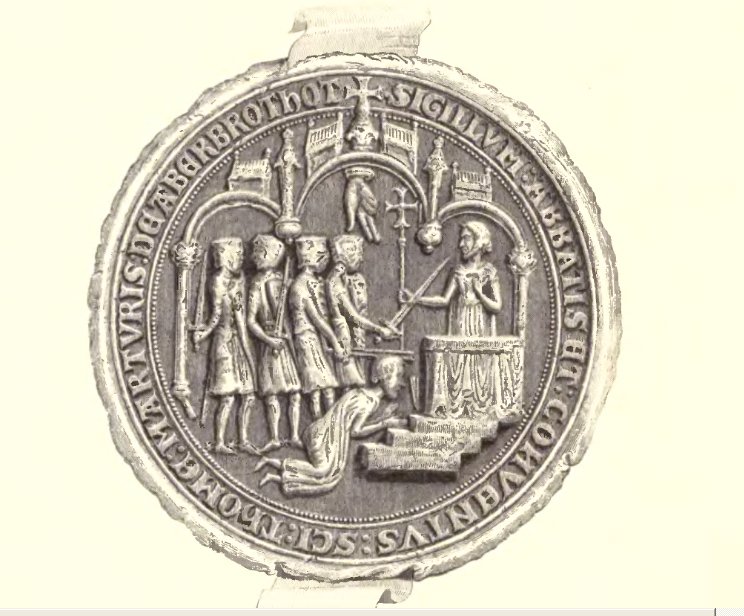
The Abbey itself is in ruins although its dedication to Thomas Becket, Saint and Martyr, is acknowledged within the town. Scots king William I, the Lion, had met Becket while a prisoner in England.
We practiced while the Una Voce members set up the altar and surrounds. It is such a blessing to return the Mass to these pre-Protestant sites, reclaiming Scotland's heritage. The Picts of the area around modern Arbroath probably heard the Mass in Latin in the 400s if not earlier.
The Abbey was founded in 1178 by William I for the Benedictines and the King was buried before the High Altar in 1214.
As Mass began, we sang the Introit 'Caritas Dei' and were a bit hesitant to start, although we picked-up towards the end. Next came the Kyrie of Missa de Angelis. And we stumbled as we heard a strong voice from the congregation, leading us at a slower pace and key (we had practised singing quietly to benefit from the acoustics). Alan reacted by drawing us in and we set off again to finish the Kyrie in good form, leading and drowning out any opposition.
We were spared congregational contributions for the Alleluia and the Sequence. I hope to put a recording of this on YouTube.
After Mass, Malky and I had lunch at the harbour before heading south.
We bought Smokies and dressed crab before leaving Arbroath.
One of us stayed awake for the entire journey home.


.jpg)